Showing posts with label iSite. Show all posts

Tuesday, August 5, 2014

Learn from Nature: Activities for Exploring Nature's Genius

After reading last week's entry, you may be thinking - I've found time to get outside, but what do I do now? Last week, we focused on the importance of getting outside and exploring nature as a part if your regular routine. This week, we will focus on what to do when you get there.

Photo by www.jennifermariephotography.net for @amycoffman
One of my favorite memories of the Biomimicry Professional program was that time spent in nature was built into course requirements. We called them "iSites" and every term I had a dozen or so structured exercises to complete. Some are simple observational exercises while others are more specific studies of particular components of an ecosystem. I have documented my contributions on this blog, so please browse the archives for 2011 and 2012 to see for yourself!

When I first started this practice, I had no idea what I was doing. As an architect with little training in the sciences after graduating from high school, it was a daunting task to go out and observe something I felt I knew little about. That's why these exercises are so powerful - they give us a chance to quiet our minds and focus on one aspect of what we observe. With this focus, we are able to see things from a fresh pair of eyes and start to ask questions. And this is the practice of biomimicry - observing nature with an eye for how things work so that those lessons may be applied to our challenges.

Tuesday, July 29, 2014

(Re)Connecting with Nature: Exploring Biomimicry in Our Local Ecosystems

Whenever I talk about biomimicry, I am usually asked a question along the lines of “how do I get started?” And the answer is remarkably simple - you start by going outside. Going for a walk through your local ecosystem, setting aside all that you need to do, reawakening your natural curiosity, and experiencing nature’s genius is a powerful act that will change your perspective on nature, your place in it, and forever alter the path of your career and life.


I recently had the opportunity to lead a biomimicry walk through the tallgrass prairie reconstruction at the Chicago Center for Green Technology, and I want to share some of the stories I tell when walking through the local ecosystems with a biomimicry lens. This article is the first in a series that explores the importance of reconnecting with nature, and how that simple act can have multiple benefits for the humans species to lead more sustainable, resilient, and connected lives.

Thursday, January 2, 2014

Waste is Normal?? Lessons from a Bird Feeder


My husband has become a birder. He hung up a bird feeder on our back porch and every few minutes or so I catch him looking outside to see who is munching away on his treats. He checked out a bird field guide from the library and keeps telling me the names of the various finches, sparrows, and our beloved cardinals that pay us a visit. His love for the birds is a treat for me to see because as a lifelong asthmatic with allergies to "everything alive", he doesn't get many opportunities to interact closely with nature. But his bird friends are perfect - he can enjoy them, learn about them, and they don't stay in his house and make him sneeze!

I can't remember the names of the bird species that pay us a visit (my memory is notoriously terrible), but remembering the names of the species isn't as appealing to me as trying to figure out how they work and what lessons we can learn from them. So what is my main takeaway from observing our bird friends so far? 

Waste is normal. 

This observation is a bit shocking to me. It flies in the face of all sustainability theory I've read and practiced for the last fifteen years, so so how can I observe that waste is normal? Because it is, when you look at component parts in isolation without seeing the larger system. Not every species can consume the entirety of the resources that are offered. Sometimes, there is waste, but this waste is readily taken up by another component, resulting in a zero-waste system.

Saturday, January 5, 2013

On the Creature Trail

We have been coming to Sanibel Island for many years, but it wasn't until I started learning about biomimicry that I really paid attention to the abundant Life that is present on this natural beach.  We took a recent trip to the beach at low tide and came across some fascinating creatures!  I even got other kids involved and one of their moms asked if I was a marine biologist.  I said no, I'm an architect, but I have an amazing instructor in biomimicry that is!  So, this post is a thank you to Biomimicry3.8's Dayna Baumeister.  Everyone involved in design should be lucky enough to learn from her and the amazing creature stories she shares.

Budding Scientists

Learning from Moon Snails

My daughter found this tiny (deceased) moon snail while walking on the beach with her Grandma.  We knew it had died because while the animal was still in the shell, it was floating and didn't retract when touched.  So we had a rare opportunity to look at it more and learn from the moon snail!

Tiny Moon Snail
I first heard of moon snails on my BPro kayaking trip to British Columbia.  We used a large moon snail shell as a "talking stick" for our opening and closing rituals, and one of the amazing biologists we kayaked with showed us the architectural egg casing that the moon snail creates using sand, seawater, and the mucus it secretes.  So when my daughter found this one, I got excited.  I showed her its foot and how it has tiny microscopic serrations that it uses to drill into clam shells, creating the little holes in the shells we used to make a necklace.
Tiny Moon Snail
We looked at the shell's gorgeous spiral shape and purplish color, the spiral a result of how it grows larger and builds its shell.  We think that the snail died because the protective cover on its foot got jammed on a slightly damaged shell edge and couldn't retract.  But this creature's misfortune gave us a chance to look at it closer.  And as the creature dried up and fell out of its shell, we got to examine it in greater detail.

Solving Mysteries on the Beach

One of my favorite things about my work is learning new things about environments I'm familiar with - going outside, exploring, and asking questions!  My family and I went walking along Sanibel Island during low tide and came upon a mystery.  We found these critters just floating in the shallow waters and had no idea what they were.  They were squishy and had "hairy" tentacles all over its back, but its belly was smooth.  We didn't know what it was, so we started to investigate and ask questions, biomimicry style.
Mystery Critter
We noticed it didn't have a shell like the other tidal organisms we found in the same area.  Why does he have a soft body when all of the other creatures here have a shell?  Especially in tidal areas, where this makes him more vulnerable to the ever present sea gulls.  What are the tentacles for?  Protection?  Camouflage?  Why was its belly so smooth and almost a thin membrane that concealed its insides?  And maybe the most interesting question - why was it here and why were they floating, seemingly lifeless?

Monday, December 31, 2012

Shelling (and Learning) with Kids

I have channeled my inner "snow bird" and flown south to Florida for a family vacation.  One of the first things we did - stopped at the beach!  Even a couple of sick kids can't keep us from the beach on New Years Eve Day.  While sitting there and digging in the sand, we found so many different shells that all had holes in them.  I channeled my inner Dayna (Baumeister, my illustrious biomimicry instructor) and explained to my daughter that the holes in the shells were not put there in order to make necklace creation easier (as she thought), but there because another type of mollusk (shelled invertebrate) drilled down into the shell with its tongue (!) and sucked out the poor clam through the hole and ate it!  The predator in this area - most likely a whelk.
Cross Barred Venus (Chione cancellata)
Lightening Whelk
"Sea snails use a radula, their ribbon-shaped tongue, to drill a hole in the shell of the clam. While drilling, the snails soften the shells by secreting carbonic acid and inserting the siphon. The clam is then digested inside its shell as the snail gulps down the remains of what Gulf Islands National Seashore park rangers call a 'clam milkshake.'" (Credit 6)

Wednesday, December 26, 2012

Teaching Biomimicry to Young Kids

I have young kids preschool and kindergarten age, and one of my favorite things to do is to show them what I do by going outside.  On a recent day in late fall, we went into our backyard and went on a critter search.  Squirrels are abundant in my backyard because of the leftover food in the garden as well as the large maple tree which dominates our small lot.  So we set about investigating and learning about the squirrels.
Squirrels and their Amazing Tails
Children learn by doing, so at first we acted like squirrels.  We brought our hands up into claws and pretended to eat an acorn.  We hopped around on two feet simultaneously.  We wiggled our rear ends.  We talked about what they ate – acorns, ideally.  In our yard, birdseed, strawberries, pumpkins, the bulbs I had planted for spring (grrr) and really anything left in the garden that we didn’t harvest.  Then we talked about what eats them – dogs and coyotes came to mind, although our dog is much too old to do more than bark at them.  Then we pretended to be a squirrel and a coyote, a glorified game of tag, which they loved!  After all that exertion and thinking, we went back inside to do a little research and drawing.  I researched, my oldest drew a squirrel from a picture, and my youngest drank hot cocoa (Chicago is cold in November!). 

Tuesday, October 2, 2012

Taking a 100 Year Nap

Sometimes it is fun to go on creative thought experiments, like what would happen to your home if you took a nap for 100 years and woke to see what it would look like without adding the human energy and capital necessary to maintain it. One day in late summer, I did just that as I sat on the driveway in my front yard watching my kids ride their bikes up and down the street.

I live in a wood frame, two-story single-family home in a downtown area of a suburb outside of Chicago. The siding is cedar and the base in the front is clad with limestone. To the east our home is a large walnut tree that hangs over our house unless it is trimmed back. At the north-west corner is another large elm tree. Both are approximately 100 years old. So, if I were to sleep for 100 years old - what would my home look like? What parts would nature reclaim and what parts would remain recognizable?

Prior to settlement, my home was a part of a larger swath of oak woodland adjacent to a tallgrass prairie, so I can imagine that through drought cycles inherent in our climate, this type of vegetation will gradually overcome some of the introduced landscaping plants so prevalent in our neighborhood.

Monday, October 1, 2012

Deeply Listening to Nature

For this iSite, I was to work on improving my listening ability - but not in listening to other humans (though that could always use some work).  I was to listen to the creatures around me on a particular place in time, defer judgement, set aside distractions, and be present.  In this instance, in the woods while camping in British Columbia.
Wildlife Tree
I started out thinking about my stomach moving and the scratch of my pen as I wrote in my journal.  I heard waves crashing at an adjacent shore and birds honking and tweeting all around me.  I began to stare at a "wildlife spire," otherwise known as the stump of a 4' diameter Douglas Fir which had become a colony of life for moss, lichen, insects, micorbes, etc.  I thought about how the destruction of one life led to life for countless others smaller than the original.  I thought of Shiva, the Hindu God of destruction that is also the bringer of life and saw the beauty in its decay.  Life is opportunistic.  It grabs resources when it can.  And Life finds a way.

Sunday, September 30, 2012

My Favorite Place (in Nature)

I wrote the following notes to myself when I was camping on a remote island near Salt Spring Island in British Columbia on a recent biomimicry trip:

Prairie
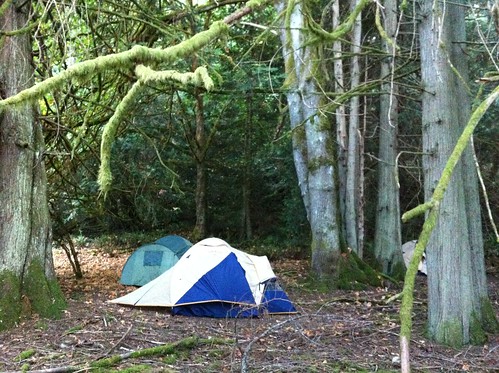
Pitching a Tent in an Enchanted Forest
"I have always felt at home in the forest.  While humans should always be aware of predators, they are few and far between in the little woods behind my house where I grew up, so I've felt at home.  I go running through the woods near my home where I live now and I love the smell of wet wood and the moist protection of the canopy on a hot day.  While I love being in the forest, I had never gotten the chance to actually remote camp in one until this trip.  The "camping" I had always done before then was usually car camping with showers or even staying in a cabin, which is not camping at all but it is a compromise I make with my husband.   
The area where we set up camp was out of a storybook fairy tale where "old man's beard" lichen coated the live and fallen limbs where everything was covered in a blanket of green.  The forest floor was a mosaic of pine cones, leaves, twigs, and all the abundant life that lives in the soil.  The tree canopy protected us from the dew and kept us much warmer than the plains adjacent to our site.  Deer chewed on fallen apples no more than 20' away from us without fear and we had our small community of friends with dreams of making the world better for all of Life's creatures.  It was a magical place full of life and connections and I hope to bring the inspiration of those connections back with me to Chicago." 
It's interesting to note the idea of cover and canopy as protection.  The tree canopy provided protection from the dew for those of us below, which kept us warmer on a cold September night.  And our tents had emulated this function by creating a drop cloth above the actual tent enclosure.  The dew hits the top cloth and rolls off, keeping the tent enclosure dry and presumably warmer.  It's fun to see how we emulate nature sometimes without even trying.  We just know it works!


Tuesday, July 31, 2012

Learning about Erosion Control from Lake Michigan Sand Dunes

How can we learn from beach grass and sand dunes to inspire more effective erosion control?

My Journal Entry on Beach Grass, abstracted

Color Filters - with children!

My children and I went for a hike with our friends on the Lake Michigan dunes in Door County, Wisconsin, this summer.  It is fantastically gorgeous there.  The water is crystal clear and you can see 10’ down – likely further but I didn’t swim out that far!  The light on the sand beach is gorgeous and there are many birds to wake up to.  There are also many trails to hike, so we did!  We decided to hike the dunes, which were forested, which was bizarre.  I don’t typically think of sand-based forests.  But walk we did.  There was a beach in the middle of the 1.5 mile hike, which gave our arms a break from carrying kids and gear.  Little legs don’t walk that far.  

On our walk, we played the “color game,” which is the color filter isite.  Walking along a trail that is mostly dark green, we looked for other colors.  We found red berries that look like raspberries but without the thorns.  We found a bush with little red berries that I’d like to know what it is.  We talked about how the red attracts the birds and animals to eat them and spread their seeds.  We saw yellow, white, and purple flowers.  Again, I think the color is to stand out from a background of dark green so that insects can pollinate them.  Color seems to symbolize “food for sex” as the author of “Prairie: A Natural History” suggests.  The dark green leaves are green for photosynthesis and dark because it’s later in the season and the chlorophyll is aging. 

Tuesday, July 24, 2012

Nature Square

Have you ever gone out into a natural environment and looked to see how many different type of species you can find within a given area?  Observations of small areas can give you a better understanding of the interdependence each species has both with each other and with its environment.
Nature Square at Springbrook Prairie

Thursday, March 22, 2012

My Failures in Composting

I've been keeping a compost pile going on six years now and I don't think I've ever had a good batch that I can use in my garden.  I'm so frustrated I'm about to give up.  I just had the last straw when I went to go turn over my (spinning drum style) composter and saw that I have an entire ecosystem of fruit flies flying around it.  Gladly, it's in an out of the way part of my yard, but it's a nuisance and a reminder that composting is an art, not a science.

Composting experts will tell you to have a 50/50 ration of "dry or brown" to "wet or green" ingredients. I tend to put more green ingredients, my kitchen and garden scraps, and forget to put in more brown ingredients, such as shredded bills, newspaper or leaves.  The result is an anaerobic mess that never quite cures and attracts pests.

But as much as I want to, I'm not giving up.  In fact, I'm doubling down and getting a cute little crock that will sit on my counter when I have kitchen scraps (instead of a plastic bag out the back) and I'm going to go dump a bunch of leaves in the composter.  Then I'll cross my fingers and hope that history does not repeat itself and I have usable compost by the time planting season begins.

An idea for entrepreneurs out there - start a composting service.  Green minded folks with no ability to compost (me) will sign up.  You can pick up our kitchen scraps once or twice a week, compost it, and then sell us back our waste in the form of local, organic garden soil.  I know the awesome community Prairie Crossing has a similar service in Gray's Lake, Illinois.  Someone needs to start one in my town.  But for all the reasons mentioned above, it won't be me.

Tuesday, March 20, 2012

Learning about Resilience from a Sea Star


Image credit: AskNature.org
I am continually amazed by the diversity of life on this planet. I remember walking the beaches of Sanibel Island as a child and seeing shells and seaweed in so many forms, and having difficulty understanding that these "things" aren't inanimate objects, but forms of life. They are all so unique and so unlike us, and there is so much we can learn from them to naturally inspire our creativity. On my recent trip back to Sanibel, I was particularly fascinated by the sea star, which as an echinoderm and related to the sand dollar, an organism that has fascinated my mother for as long as I can remember. Thinking about the sea star's regeneration abilities got me thinking about natural resilience, so I did a little research.

We all learned in grammar school that a starfish can regenerate limbs and even reproduce asexually from a severed arm when they are attacked by a predator (talk about leveraging disturbance to your advantage!). And this ability alone is amazing, but their structure is equally so. The five arms that reach out from a central core, called pentaradial symmetry (think soccer ball, instead of the bi-lateral symmetry that we have), has inspired architects and packaging designers with its efficient 3D enclosure. But when I looked at a real (albeit taxidermic) starfish that my daughter picked up at a souvenir shop, what I was most curious about was the texture.

The sea star is covered in thousands of bumps of varying sizes. Large protruding bumps, small recessed bumps, all which serve its radial geometry. But there had to be there for a reason other than looking good. So, I looked it up in the amazing website AskNature.org and found out that the holes I saw on the surface of the organism are also present at a microscopic level. The reason for these macro and microscopic holes have to do with its resilience to fracture. By creating thousands (millions?) of holes, tiny cracks that try to form in the structure of its limbs cannot become very big before they hit a hole and are stopped. Creating tiny holes also lessens the amount of material the organism must create, saving energy. True multi-functional design!

What I found through my research was that the sea star is also an indicator species. The sea star is greatly affected by water quality because the pump untreated water directly into their bodies through their vascular system. Therefor, mass die-offs of a population will indicate that toxins or contaminants have disturbed the water, such as an oil spill.

Lessons for natural resilience:
  • Create business structures that can survive, reproduce, and thrive after being severed from the main organization due to disturbance. 
  • Use material efficiently. 
  • When a system is vulnerable to one particular type of stress, look for structural or built-in ways to arrest that disturbance before it is allowed to grow too large. 
  • Create barriers to yourself and your environment. 
  • Create filters or similar structures that provide a buffer for you from the elements so that you have a chance to react before it is too late to respond. Or, create test subjects to test the elements for you. 

References:
http://www.asknature.org/strategy/7766025228ecd836d440f23c9abd4662
http://www.asknature.org/strategy/fd3f0f7a35b9d82aa7328af1881fafbf
http://en.wikipedia.org/wiki/Starfish

The Bees are Out - and it's March!


Photo credit: AskNature.org
As I sit here in my backyard on this record breaking warm day in March, I am buzzed by bees and wasps flying near my head.  While this is a startling occasion at any time, I wondered how the bees will fare when this unseasonably warm weather cools to the normally chilly spring that we normally have.  We will still have a frost, right?  And thinking about it, how do bees survive Chicago winters at all?  And is there anything we can learn from them?

Tuesday, March 6, 2012

How do you recreate Africa in Orlando?


I recently returned from my first trip to Disney World in Orlando, Florida for the first time in over twenty years and I'm exhausted, but my kids had a great time. At 2 and 4, they were rather overwhelmed, but my 2 year old son really took toAnimal Kingdom, which was the one I was most looking forward to as well. And it got me thinking - how did the designers really make it possible that the flora and fauna that is adapted to an African climate can survive in a former swamp like Orlando? I would have thought that the two climates would be too different, but as I sat outside of my room at the Animal Kingdom at night with a constructed savanna outside my balcony, they somehow did it.

Africa is so large that it encompasses the majority of biomes on the planet, from arid desert to tropical rain forest, and the animals at Animal Kingdom are from a variety of African climates, from the savanna to the forest to the swamps. But the Disney experience is only possible, of course, with heavy management and density. It is a zoo on steroids and it could not exist without heavy management - tigers sit atop a constructed hill just above gazelles, separated by a carefully concealed electrical fence. Fish swim in ponds so densely they are rarely 6" from another. Alligators climb on each other for sunny perches. And from my balcony, I would see managers driving in food for the zebras and giraffes to eat because they are too densely packed to survive by grazing.

But in it's own way, it's lovely. Although a true African safari is still on my "bucket list", it is far off in my future. And the ability to travel a few hours from my parent's home in south Florida and see large, magnificent animals is an experience I'm glad to have had - and to expose my children to. On a 25-minute safari, I saw all of this as well as termite mounds which I thought were just for show but supposedly they are real because certain animals feed off of them. And the Lion King show was fantastic! Seriously - FANTASTIC.

I'm not sure how much I learned about the world by coming here, but my kids had a good time seeing exotic animals and being outside all day. And they now love to hear me read about different animals from the First Animal Encyclopedia I bought there, so it was worth it.

Saturday, February 25, 2012

Ding Darling

I remember my Grandfather picking me up at the airport on our first trip to Sanibel Island.  I was 9 years old and we were missing school for a whole week to go to Florida and stay with them.  All I wanted to do was go to pool, but he insisted on driving through the Ding Darling Wildlife Reserve.  At the time, I was bored and hot in my long sleeve dress, but now that I am older, I finally understand why my grandfather was so in love with the reserve and Sanibel Island in general.  It is a barrier island that has set aside over 30% of its land mass to a nature preserve and every beach is natural and unmanicured.  It provides a glimpse of the life in the sea that we sometimes forget is there when staying at resorts.

Notes on the mangrove and horseshoe crab
On a recent trip, we went on a guided trolley ride through the Ding Darling where I learned more about the island I have been visiting for so many years.  Some of the interesting things I learned about mangroves:

  • Red mangroves grow in the lowest, wettest conditions and prop their roots up above the water to breathe through pores in their bark during low tide.
  • Black mangroves grow slightly higher up in elevation and breathe through snorkel like straws that stay above the water.  Their leaves glisten in the sun as they rid themselves of the salt from the water.
  • 50% of hurricane winds are blocked by mangroves and their roots help to dissipate wave energy
  • Mangroves store salt in vacuoles and then shed them in their leaves.


Spanish Moss

While in Florida, I couldn't help but notice the Spanish Moss (tillandsia usneoides) that hung from every tree. I wondered why it was there and what, if any, benefit it provided for the host tree on which it hung.

Spanish Moss
It turns out the moss is not beneficial for its host.  While it doesn't kill the tree, it lowers its growth rate by blocking light and increases wind resistance, which can be fatal in a hurricane.  It does, however, provide shelter for creatures such as rat snakes, bats, and jumping spiders (which are only found on Spanish moss).  It has uses for humans as well, such as building insulation, mulch, packing material, and mattress bedding.  

While we like to emphasize Nature's ability to create cooperative, mutualistic relationships, sometimes in the process of niche differentiation, resources are available and mutations present to create parasitic relationships  such as this one.  But it is interesting to note that while it is a parasitic relationship, it is not usually fatal to the host and creates benefits for the ecosystem as a whole.