Showing posts with label resilience. Show all posts
Friday, May 27, 2016
Stories of a Place: Exploring Resilience Strategies at Home
My work is centered on understanding nature's resilience strategies and exploring ways that we can learn from them to embed resilience into human systems, such as communities, businesses, and our built environment. It's a fascinating topic that continually enriches my work life, and one that I am interested in exploring at home as well!
I have decided to make my home the test bed for how nature's resilience strategies can be showcased at home. Please follow what I plan will be a series of posts about my progress toward making a resilient (re)design of a suburban home, one that is inspired by the "Stories of our Place!"
Tuesday, May 26, 2015
Collective Resilience
Mention the term "swarm theory" and people typically think of robots that work together or accident-avoiding cars, but conversations I've been having recently are all about bringing swarm theory to work for human behavior. In a nutshell: how can we set up structures within our businesses, organizations, and communities that incentivize individuals to work together toward a common goal?
I've written about swarm theory in relation to communication issues in a previous entry, and building on that, how can we leverage the mechanisms behind this innate behavior to create strategic alignment for our businesses and communities? The mechanisms in swarm theory are simple: individual organisms working together to create a whole that is greater than the sum of their parts. Through information transparency, multiple sensors, and simple rules, flocks and swarms are able to leverage the self-interest of the individual to work together and mitigate disturbances, such as predation. The biological mechanisms are simple, but translating them to a human context is anything but elementary.
Perhaps you are asking yourself:
How can I grow my business while keeping my culture intact? How can my organization cut through the noise to spread the word on an important initiative? How can I organize my community to collectively tackle initiatives that mitigate the effects of urban flooding, crime, and climate change?
Let's start learning from billions of years of nature's R&D and work together to bring natural solutions to work for our businesses, organizations, and communities. Contact us to learn more!
Resources to learn more!
- The B-Collaborative's Naturally Resilient Workshop.
- National Geographic's interesting introduction to swarm theory (bit of a long read);
- For a shorter experience, NatGeo created a picture essay on the subject;
- HBR article for a Capital One case study that applies swarm theory to human behavior;
- And for an example of it applied to energy management, the REGEN case study.
Wednesday, September 24, 2014
Stories from the Prairie: Applying the “Genius of our Place” to Unlock Nature’s Strategies for Resilient, Restorative Design
Nature is inherently resilient and restorative while our human systems are...not. But what could we learn about the nature of design by studying the science of nature? By exploring our native organisms and ecosystems with a biomimicry lens, we can unlock nature’s locally-attuned design strategies and begin to apply them to our context: creating buildings, businesses and communities that are inherently sustainable, naturally.
In the other articles in this series, I wrote about the importance of connecting with nature and ways to do so. In this last (for a time, at least) article in this series, I share some stories of what I've learned in my exploration of the tallgrass prairie as well as a vision for a more sustainable and resilient world: one where our choices are based on working with and leveraging local context and energy flows rather than fighting against them.
Like Wes Jackson who was inspired by the prairie to rethink industrial agriculture to Allan Savory who emulates grazing for holistic land management and Gerould Wilhelm who emulates the prairie in landscape design, each of these innovators look to the prairie ecosystem as inspiration for alternatives to standard practice. Doing so, they were able to (re)think standard practices, creating more low-maintenance, cost-effective, and biodiverse alternatives. And you can do this too.
![]() |
| Lurie Gardens. Photo by @amycoffman |
It’s time to start thinking differently.
Tuesday, July 29, 2014
(Re)Connecting with Nature: Exploring Biomimicry in Our Local Ecosystems
Whenever I talk about biomimicry, I am usually asked a question along the lines of “how do I get started?” And the answer is remarkably simple - you start by going outside. Going for a walk through your local ecosystem, setting aside all that you need to do, reawakening your natural curiosity, and experiencing nature’s genius is a powerful act that will change your perspective on nature, your place in it, and forever alter the path of your career and life.
I recently had the opportunity to lead a biomimicry walk through the tallgrass prairie reconstruction at the Chicago Center for Green Technology, and I want to share some of the stories I tell when walking through the local ecosystems with a biomimicry lens. This article is the first in a series that explores the importance of reconnecting with nature, and how that simple act can have multiple benefits for the humans species to lead more sustainable, resilient, and connected lives.
Wednesday, May 7, 2014
Dormancy as an Energy Strategy: Learning from our Native Prairie
It’s been a long winter! Can you remember last summer’s lush green prairies when looking at them today, just emerging from their brown and dormant stage? As we drag ourselves out of our own winter dormancy and into the full light of spring, let’s take a moment to consider how our buildings and businesses can begin to emulate the biomimicry Life’s Principle to “Leverage Cyclic Processes” by embedding the ability to automatically respond to local conditions.
By understanding how ecosystems, like our native tallgrass prairie, are attuned to local conditions, we can begin to design buildings that optimize resource allocation while being more responsive to user needs.
Thursday, December 19, 2013
Learning Resilience from our Immune Systems!
My daughter and I have been sick with the flu for a week now. This is a typical fate this time of year when viruses linger in the air. But last night as I told her the story of her immune system, I was grateful to my biologist collaborator, Maria O'Farrell, who during the creation of our "BEND, Don't Break" Naturally Resilient workshop, taught me all about my immune system so that I could tell it to my daughter. The story I told her goes a little something like this:
"Once upon a time, there was a virus. This virus came into our house on the hands of a little boy, otherwise known as brother-the-carrier-monkey. He picked it up at school by touching something and then touching his eyes or mouth. He then came home and touched many things in our house. Meanwhile, this virus was not alone - it was busy invading our cells and having babies and its babies were having babies, until there was virus all over our house...and in our bodies. And we got sick.
But then, an amazing thing happened! We fought back! Our bodies have an immune system - something akin to a police force that is always running throughout our bodies to determine which parts are "me" and which invaders are "not me." When the police (white blood cells) find something that is "not me," or just not right, they send out a signal to other police cells to see if they found an invader too. If they both have an invader - and know that others do too - they pass a threshold for action and tag the invader for destruction! Then, the police cells go for backup. They go back to police headquarters (the closest lymph node) and replicate themselves (but a new and improved version that can better fight the invader!) who then return in full force to attack the virus and they beat it up until it explodes! And this is happening all over your body and will keep happening, until all the virus is dead.
So you see, your body is resilient! By looking out for potential problems, knowing when there is enough of a problem to react, and learning from experience, your body is able to not over react or under react to potential harm, but your response is, like Goldilocks, just right. Think about what it would be like to not have an immune system! We couldn't live on this planet because we literally swim in viruses in the air like a fish swims through plankton in water. Now think about THAT as you go to sleep tonight!"What can we learn about resilience from our immune system?
Our immune systems are our body's adaptive strategy to respond to disturbances that we know will happen, but we don't know when and we don't know how bad it will be. And there is quite a bit we can learn about resilience from adaptive immune systems.
What instances can you think of where we know a disturbance will happen, but we don't know when and we don't know how bad it will be? This makes me think of economic fluctuations, talent migration
necessitating personnel changes, energy and maintenance costs fluctuations, and other cyclical and
expected disturbances. By looking at nature through the lens of antigen invasion in an adaptive immune system, we can begin to create human systems which effectively adapt to changing conditions and result in effective, efficient information exchange coupled with a regulated response and held in balance by feedback loops. I could go into more detail, but again, I have the flu and the resources usually allocated to my brain are currently being rerouted to my immune system.
Want to know more? Talk to us about our "BEND, Don't Break Naturally Resilient Workshop" where you can learn more about this and other biological phenomena and apply nature's lessons to your business or organization!
What instances can you think of where we know a disturbance will happen, but we don't know when and we don't know how bad it will be? This makes me think of economic fluctuations, talent migration
necessitating personnel changes, energy and maintenance costs fluctuations, and other cyclical and
expected disturbances. By looking at nature through the lens of antigen invasion in an adaptive immune system, we can begin to create human systems which effectively adapt to changing conditions and result in effective, efficient information exchange coupled with a regulated response and held in balance by feedback loops. I could go into more detail, but again, I have the flu and the resources usually allocated to my brain are currently being rerouted to my immune system.
Want to know more? Talk to us about our "BEND, Don't Break Naturally Resilient Workshop" where you can learn more about this and other biological phenomena and apply nature's lessons to your business or organization!
Tuesday, November 19, 2013
Resilience in the Midwest: How does nature buffer high speed winds?
Those of us who live in the American Upper Midwest have it pretty
good.
Although we rarely take the time to acknowledge it, comparatively to other more vulnerable regions in the globe, we are living in an ideal location. We live in the breadbasket and grow more than enough food to feed ourselves.
We’re well above sea level, so we will not be affected by anticipated sea level
rise. And we have the world’s largest accessible freshwater body – the Great
Lakes – in our back yard. But, we still have our own forms
of adversity with which we need to contend - and the tornado that flattened
homes outside of Peoria, Illinois, this weekend proves that even inland areas must adapt to the
challenge of increasing storm intensity.
| Chris Walker, Chicago Tribune, Nov. 18, 2013 |
According to the Chicago Climate Action Plan, it is likely our
region will experience a variety of disturbances, including stronger,
but infrequent, storms causing wind damage, widespread flooding and/or
intermittent drought. In the wake of the recent tornado that wrecked communities across
Illinois, let’s start with wind damage – how
can we make our homes and infrastructure more resilient to damaging wind
speeds? As an architect and biomimic, I believe the answer can be found by
looking at how our neighbors, the native organisms that have occupied this land
long before we have, solve the same challenge. We can start by asking nature!
How does nature...buffer high
speed winds?
Every time there is a large storm event, we see absolute devastation
of our human habitats. There are no metrics to measure the wildlife populations before and after strong storm events, such as tornadoes, but it's safe to say that native populations have adapted themselves to survive and thrive through a variety of disturbances. By looking to native
organisms and patterns found in nature, we can begin to think of new and innovative ways of surviving high wind speeds in our built infrastructure. Some patterns we find in nature include:Monday, November 18, 2013
Communication...issues
Indulge me for a minute as I complain about something that is clearly a first world problem: communication breakdowns between me and my communications provider (the irony is not lost).
After years of paying a ridiculous amount of money to have multiple carriers provide what has become a basic service in our society - communication services - I chose consolidation: a non-diversified, less-resilient strategy, but much, much cheaper. When ordering the service, I thought I had asked all the right questions - how much will it cost now, how much in the future, what channels will I get, how fast will my internet be, can I keep my old number, etc. I did what I thought was my due diligence to make sure I was ordering what I needed/wanted. But the cost I was quoted did not include some services, such as HDTV, that they consider to be an upcharge and I consider to be "basic," so much so that I didn't inquire about it assuming it was included and they didn't offer this information as the upcharge that they consider it to be. This lack of transparency about the baseline assumptions of our conversation lead to a communication breakdown and annoyance on the part of the consumer, namely me.
This problem illustrates a key point for resilience in human systems: one of the most common forms of disturbance in our business and economic systems involve communication breakdowns, and mitigating these disturbances is key to resilience of those systems.
Thursday, November 14, 2013
If there ever was a case for community resilience...
...it would be the movie The Purge with Ethan Hawk. Have you seen it? My husband and I rented it last night and it got me thinking about this idea of personal resilience and how it falls short when you need it most.
The premise of this film is a dystopic America where crime and poverty are minimal because everyone is given a free pass one night a year to commit any crime they want, including murder, to purge themselves of pent up aggression and hostility they feel during the rest of the year.
There are two types of people in this society - those that commit the acts of aggression and murder and those that hole themselves up indoors waiting for the night to be over. Most of us would put ourselves firmly in the second camp - we'd stockpile food and water, build the best security systems to protect ourselves and our property, and hold our families close as we ride out the night and hope to survive. This is the premise that interested me about this arguably flawed movie (at the end of the film, my husband and I were laughing at it's implausibility that fundamentally misunderstands humanity, but this is a spoiler free zone so I will save that discussion for those of you who have seen it).
To me, this movie illustrates that the focus on survivalism and personal resilience at the cost of everyone else deprives us of our humanity and is fundamentally impossible to achieve.
Tuesday, October 1, 2013
Blog Post: Resilient Communities on the Edge
How can we learn from ecosystems in nature to design more resilient communities? The B-Collaborative founder, Amy Coffman Phillips, wrote an article on this topic for The Resiliency Institute, a local suburban permaculture advocacy group. Read the article and let us know what you think!
![]() |
| Ecotones in Nature (creative commons image credit: wikipedia.org) |
Click here to continue reading."Studies have shown that America has become much more polarized in the last twenty-five years in terms of race, socioeconomic status, and particularly political world views. These divisions have been exacerbated by structural forces, such as fragmented news media, increasing disparity of socio-economic conditions, and indoctrinated societal world-views, to name a few.Each of these barriers are complex and interrelated, but if you accept we have inadvertently created these structural barriers that serve to disconnect our communities, we should be able to identify and break down these barriers as well. Doing so would foster interconnected, resilient communities that are able to resolve disputes and weather disturbance more effectively than is possible today.As a biomimic and architect, I look to nature for inspiration to design buildings, communities, and cities that function more like a healthy ecosystem – rich with interconnections, diversity, and mutualisms. Lately, I’ve been thinking a lot about ecotones. Until last year, I wouldn’t have even known what that term meant, but now I see them and think about the parallels between ecosystem communities and our human communities every day. So what is an ecotone and what could we learn from ecosystems in nature to inspire more diverse, interconnected, and resilient communities?"
Wednesday, September 11, 2013
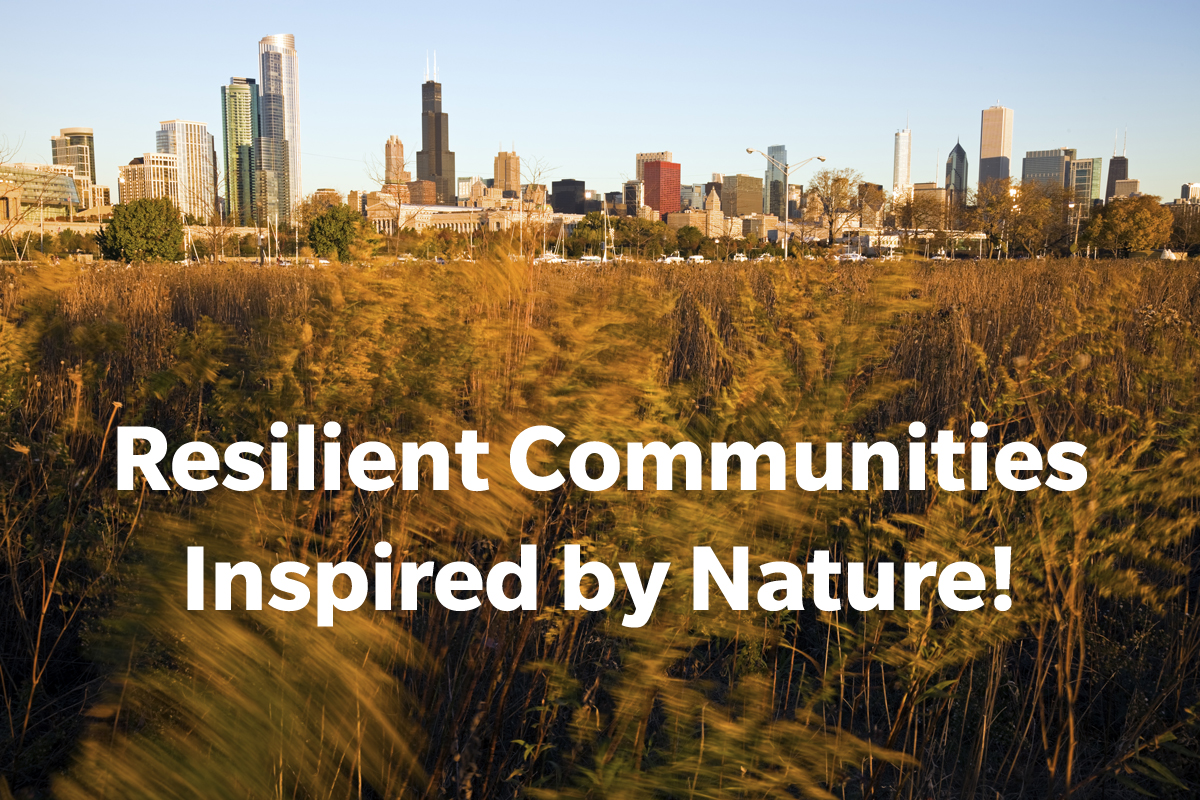
Resilient Communities Inspired by Nature
The B-Collaborative's founder Amy Coffman Phillips recently wrote an article on resilient communities inspired by nature for the Great Lakes Bioneers Chicago blog (edit: website no longer functional so article reposted below). Let's start a conversation about local resiliency for our communities by looking to Nature's communities as inspiration.
A lot of attention is being paid to resilience of late. In the wake of Superstorm Sandy, communities across the eastern seaboard and beyond are beginning to plan for disasters associated with climate change or other occurrences beyond our control.
The Rockefeller Foundation, the initiators of the new “100 Resilient Cities Centennial Challenge” define building resilience as “about making people, communities and systems better prepared to withstand catastrophic events – both natural and manmade – and able to bounce back more quickly and emerge stronger from these shocks and stresses.” They see resilience in cities as crucial to the resilience of our global community and they have backed their challenge with funding to provide technical support and resources to select local governments as they plan their urban resilience initiatives.
Chicago and its regional municipalities should explore opportunities to be a part of this initiative. Doing so will leverage our background in cutting-edge sustainability and showcase the need for resilience in America’s heartland.
But why is it so important that our cities embody resilience? And what does it mean to be resilient in the midwest? This is a topic we are exploring in this article and at the Great Lakes Bioneers Conference in Chicago this November 1st through 3rd. Let’s start by having a conversation about and planning for community resilience now, so that we can plan for and address our challenges – before a potential crisis occurs.
The Case for Resilient Cities
Many homeowners realize the need to be prepared and protect their homes from disasters, at varying levels from stockpiling food to purchasing a gas generator. But simply making ourselves more self-sustaining at this micro-scale is a short-term strategy – having enough food and fuel will make little difference if the whole town is on fire. At the other end of the spectrum, the federal government prepares for emergencies through the Federal Emergency Management Agency in affiliation with state agencies, but this macro-level, centralized approach to disaster management is often fraught with inefficiencies and delays.
It is therefore imperative that we address issues of adaptation and resilience at the local level; this middle (meso) scale, from mega-cities like Chicago to its outlying suburbs, large and small, even neighborhoods within a larger community. By embedding resilience into our social, economic and built infrastructure at multiple scales, we can build vibrant, resilient communities that support each other – lessening losses, adapting to changing conditions, and rebounding quicker to save money and lives.
A Resilient Chicago Metropolitan Region
Some may question the need to worry about resilience to the effects of climate change in Chicago when we are located well above sea level and have the largest available freshwater source on the planet in our back yard. It’s true that our location protects us from some of the more severe impacts of climate change and we are in a better position to weather its effects than many coastal communities. But our region is not without its challenges. According to the Chicago Climate Action Plan, it is likely our region will experience:
- Stronger, but infrequent, storms causing wind damage, widespread flooding and/or intermittent drought;
- Species migrations and extinctions, adversely affecting our local ecology and food production;
- Dangerous heat waves, resulting in pollution and its health impacts; and
- Continual draining without recharge of the glacial-remnant Lake Michigan water, leading to lessening availability and pollution of this precious resource.
Natural Inspiration
In the process of striving to reduce waste and improve the quality of life for our region’s inhabitants, the sustainability movement has prepared us for the resiliency challenge by systematically embedding new and diverse offerings to address the needs of the market. At a systems level, resiliency is born by embedding redundancies and diversities into a system at a variety of scales.One example of this principle can be seen in alternative transportation options, such as car share and bike share programs along with more robust bicycle infrastructure. By providing alternatives for the daily commute, these market-based programs reduce emissions and fossil fuel use, while at the same time embedding resiliency because they operate at different scales and use different fuel sources.
In this example, if a disturbance affects the electrical grid on a large scale, the electric commuter rail will be affected, but the petroleum fueled cars and caloric body energy fueled bicycles will be able to compensate for this loss and continue to operate through the disturbance. By providing different options to get to work, which work parallel to but operate differently than the existing options, we embed resilience into our communities and their vital infrastructure.
This deep principle of cross-scale embedded redundancy and diversity draws inspiration from nature’s naturally resilient ecosystems. For example, in our native tallgrass prairie, there are many different types of grasses that accomplish the function of photosynthesis. They operate without inefficiencies because they are different from each other in significant ways, such as how much water they need or what temperatures they are able to photosynthesize. These characteristics allow them to respond differently to changing environmental conditions and capture resources at different times. In wetter seasons, or in different microclimates, different types of grass may be dominant versus in dryer seasons, but the systemic function of photosynthesis remains.
Translating the principles found in nature to a human context is the practice of biomimicry. When viewing nature from a systems perspective, we are able to recognize that human systems are a part of natural systems, subject to the same constraints and abundances as the rest of life. By looking at other complex, adaptive systems for inspiration, we are able to translate their lessons into our own context so that we can embed locally-attuned, context specific resiliency strategies for our region.
Start a Conversation
We think of the Bioneers movement and our upcoming conference as a bridge between sustainability and natural inspiration, providing thought provoking conversation and useful tools to address the challenges we face in our communities. This topic will be explored in detail at the “Community Resilience” session on Friday, November 1st and the “Community Resilience Inspired by Nature” workshop on Sunday, November 3rd.And we want to hear from you - how do you think we embody resilience in our communities? And how can we as Bioneers add value to this conversation by looking to sources of natural inspiration? Let’s work together to embed resilience into our local communities prior to disturbance, so that our communities are able to not only survive but thrive through adversity.
About the Author
Amy Coffman Phillips is an architect, MBA, and Certified Biomimicry Professional. She founded The B-Collaborative, an education and design consultancy, to catalyze and facilitate naturally-inspired sustainable design projects. Their flagship product is the "Naturally Resilient" workshop for business and non-profit leaders looking to embed Nature’s resilience strategies into their strategic planning initiatives. She is also a partner and adult educator at Prairie Lab, LLC, a professional development firm, and is co-founder of Biomimicry Chicago, a local resource for naturally inspired sustainable design.Sources
“100 Resilient Cities Centennial Challenge”
Great Lakes Bioneers Conference
Chicago Climate Action Plan
Biomimicry’s Life’s Principles
BEND’s “Naturally Resilient" Workshop
AskNature
Tuesday, July 24, 2012
Nature Square
![]() |
| Nature Square at Springbrook Prairie |
Tuesday, March 20, 2012
Learning about Resilience from a Sea Star
![]() |
| Image credit: AskNature.org |
We all learned in grammar school that a starfish can regenerate limbs and even reproduce asexually from a severed arm when they are attacked by a predator (talk about leveraging disturbance to your advantage!). And this ability alone is amazing, but their structure is equally so. The five arms that reach out from a central core, called pentaradial symmetry (think soccer ball, instead of the bi-lateral symmetry that we have), has inspired architects and packaging designers with its efficient 3D enclosure. But when I looked at a real (albeit taxidermic) starfish that my daughter picked up at a souvenir shop, what I was most curious about was the texture.
The sea star is covered in thousands of bumps of varying sizes. Large protruding bumps, small recessed bumps, all which serve its radial geometry. But there had to be there for a reason other than looking good. So, I looked it up in the amazing website AskNature.org and found out that the holes I saw on the surface of the organism are also present at a microscopic level. The reason for these macro and microscopic holes have to do with its resilience to fracture. By creating thousands (millions?) of holes, tiny cracks that try to form in the structure of its limbs cannot become very big before they hit a hole and are stopped. Creating tiny holes also lessens the amount of material the organism must create, saving energy. True multi-functional design!
What I found through my research was that the sea star is also an indicator species. The sea star is greatly affected by water quality because the pump untreated water directly into their bodies through their vascular system. Therefor, mass die-offs of a population will indicate that toxins or contaminants have disturbed the water, such as an oil spill.
Lessons for natural resilience:
- Create business structures that can survive, reproduce, and thrive after being severed from the main organization due to disturbance.
- Use material efficiently.
- When a system is vulnerable to one particular type of stress, look for structural or built-in ways to arrest that disturbance before it is allowed to grow too large.
- Create barriers to yourself and your environment.
- Create filters or similar structures that provide a buffer for you from the elements so that you have a chance to react before it is too late to respond. Or, create test subjects to test the elements for you.
References:
http://www.asknature.org/strategy/7766025228ecd836d440f23c9abd4662
http://www.asknature.org/strategy/fd3f0f7a35b9d82aa7328af1881fafbf
http://en.wikipedia.org/wiki/Starfish
Thursday, February 9, 2012
So the groundhog got me thinking...
...how do animals adapt to freezing Chicago winters?
Humans seal ourselves off in conditioned homes and cars, burning a lot of fossil fuel energy to do so. But animals don't have that option. So how do they do it? I decided to revisit my grade school classes and relearn what I've forgotten. And maybe there is something we can learn for design.
Groundhogs
Groundhog Day got me think, of course, about groundhogs. As I learned in grade school, they do in fact hibernate from approximately October to March, but toward the end of hibernation (oh, say February 2nd or so?), they enter various stages of arousal to test the temperature and scope out new territory before entering into a semi-hibernated state like torpor. The purpose of hibernation, of course, is to conserve calories when food is scarce, so the animal's metabolic rate slows and the body cools, respiration and heart rate are depressed. Groundhogs enter into obligate hibernation, where they are aroused by internal mechanisms and usually unable to be aroused due to external stimluli. Other animals enter into facultative hibernation, or semi-hibernation, where they are able to be aroused but the purpose is the same: conserve energy when it is scarce.
Humans seal ourselves off in conditioned homes and cars, burning a lot of fossil fuel energy to do so. But animals don't have that option. So how do they do it? I decided to revisit my grade school classes and relearn what I've forgotten. And maybe there is something we can learn for design.
Groundhogs
![]() |
| Photo credit: National Geographic Society |
Labels:
biomimicry,
iSite,
resilience
Location:
Chicago, IL, USA
Subscribe to:
Posts (Atom)