Sunday, November 13, 2016

Thoughts on Reorganization

Photo by ACP at the Morton Arboretum
Note to the reader: this won't be a polished blog entry, because my thoughts are too raw and unformed as yet. This is a therapeutic exercise I am undertaking as I try to figure out where I and others like me fit in within this radically changed landscape. 

"Change is the only constant in life." - Heraclitus, a Greek philosopher


I have devoted my career to sustainability and resilience. For the first ten years, I used this as an architect, and for the last five it has been as an advocate and educator. I had optimism that even though my goals were large, complex, and long-term I was helping people to see their challenges in a different way. I thought that by helping people to think differently, I could help create a movement that moved our society and our world toward a more environmentally and socially just existence.

And then November 8th happened.

That night, I began to realize that I have been living in a bubble. My privileged existence of contemplating large scale, long-term change cannot be realized when people are hurting and worry for how they will exist the next day. I remember hearing Wangari Maathai say that people would cut down the last tree to burn so they can feed their children. And my mentor, Dayna Baumeister, telling us that we cannot appeal to rational solutions when people are hurting, our brains simply won't allow us to process future thinking when we must deal with today's survival.

I am beginning to realize more and more that environmental justice cannot occur when social justice is so far from our reach. It is sad for me to think that we as a nation and as a global community are not as evolved as I thought we were. Misogyny, racism, and elitism are far more wide-spread than I had thought they were. And as someone who heeds the warning of 99% of the scientific community that we are headed for global disruption at a scale we have never seen, I am horrified that we need to refocus - AGAIN - on short-term triage rather than long-term solutions.

So where does this leave us? Where do we go from here? Here are my thoughts as of this writing.

Task #1: Build Bridges for Social Resilience


I will start with helping to heal my local community. We are as divided as any other community in this country: red vs blue, rich vs poor, white vs non. We all live in bubbles of our own making by the news we read, the friends we have, and the places we live. We need to find ways to build bridges, not walls and to stand up for those that feel unsafe in this changed landscape. True community resilience can only occur when we hold each other close and focus on what we have in common more so than what divides us - even those we disagree with.
"It is better to light a candle rather than curse the darkness." - Eleanor Roosevelt. 

Task #2: Refocus Environmental Resilience, Locally


It is now clear that we cannot rely on outside forces to shape our destiny. We cannot rely on the federal government to make the changes we need to see - we can only rely on ourselves. As a community and as a bio-region, we must take charge of our own destiny and focus on how we can sustain ourselves and our communities as conditions change. Local governments, industries, and activists must work together to build and sustain initiatives that will help all of our citizens work together to create a socially and environmentally just place for all of us to thrive. Women and minorities (as well as our male allies) of all generations must empower each other and organize to collectively ensure the rhetoric, actions, and policies of this toxic campaign are not normalized.

The forces of injustice and unsustainability have been emboldened. It is up to us to stand collectively to fight for our way of life and the future our children will inhabit. We can be a beacon of light in the darkness and others will follow our example.

Task #3: Continue to Learn from Nature

Now, more than ever, we need to learn from our mentors. Those organisms and ecosystems that have survived here for millennia - through countless disturbances far greater than the ones we face now. They have learned to not only survive but THRIVE in this place, and we can do this too.

  • We can learn from the lowly dandelion how to change ourselves to fit the conditions in which we find ourselves - so that when we land in less-than optimal conditions, we can grow and set seed quickly so that our information survives when we cannot. But regardless of the conditions, we will still grow, but it will be different.
  • We cannot wait for a charismatic leader to show us the way. That ancestral tribal thinking of dividing us vs them empowered the Trump campaign to victory, but it has also lead to social unrest on the scale we haven't seen for a generation. We must begin to look to new models of collective action, like the collective animal behavior of birds, bees, and bison. Through information transparency, simple, system-wide rules, and thresholds for action we can begin to self-organize and move collectively in a common direction.
  • We must also look to ecosystem models of diversity, redundancy, and multi-scale reinforcement as the mechanisms upon which resilience emerges. By welcoming all types of diversity - not only racial but also a diversity of thought, strengthening our numbers, and forming multi-generational, multi-regional coalitions, we can begin the process of building bridges and healing. 

When a tornado rips through a woodland, the destruction is catastrophic and the standard way of life is temporarily halted. But slowly, the forest rebuilds. The Hindu God Shiva, the God of Destruction, opens the path to rebirth. Young trees feed off the nutrients of those that have fallen, creating a multi-generational canopy that is more resilient in the long-term than it would be had the disturbance never happened. Our strength is in our diversity, and true resilience can emerge after catastrophic events. But we must begin to reorganize now.

I am deeply saddened by the turn our country, as well as many parts of the world, has taken. And while I mourn, I also see this an opportunity for mobilization of grass roots activism on a scale that is unprecedented. Now is not the time to run, it's the time to stand and fight for our country as well as be open to the changes this type of reorganization will bring. I will always believe that we are "Stronger Together" and I am grateful for the opportunity to contribute my talents toward creating a better world for everyone.

We can do this. Together.

Thursday, July 7, 2016

Aspiring to be the drop

The owner of my gym posted this today and I've been thinking about this all day: it's an analogy for how we can make a difference by staying focused and taking actions in a slow and steady way.
"The weakest living creature, by concentrating his powers on a single object, can accomplish good results while the strongest, by dispersing his effort over many chores, may fail to accomplish anything. Drops of water, by continually falling, hone their passage through the hardest of rocks but the hasty torrent rushes over it with hideous uproar and leaves no trace behind." - Og Mandino.
Many of us working for social change find ourselves pulled in many directions. I continually wonder where my time and energy would have the most effect? When does a great idea start to take precedence over the good ones, and how do I prioritize? 

I have three primary goals with my work: 
  1. Improve the lives of people and all organisms in my bioregion;
  2. Choose projects that are financially sustainable; and 
  3. Be physically and mentally present for my family when they need me. 
That's it! It really shouldn't be as difficult as it has been to accomplish all three goals with each action I take, but trust me - it is. Most social justice initiatives do not pay at all or pay very little, so #1 and #2 can be in conflict. And accomplishing #3 is most times in conflict with #1 and #2. So what to do? Refer back to the quote:
"The weakest living creature, by concentrating his powers on a single object, can accomplish good results while the strongest, by dispersing his effort over many chores, may fail to accomplish anything."
Too often, I disperse my brainpower and efforts over many tasks - see my 3 goals above! But doing so accomplishes very little. My goal for the month of July is to focus on one goal and use the time I have to work toward that end.
"Drops of water, by continually falling, hone their passage through the hardest of rocks but the hasty torrent rushes over it with hideous uproar and leaves no trace behind."
I also need to remember that I am a drop. Too often, I am distracted by the latest catastrophe and rush to see how I can help with that, but my goal should be to keep focused and take actions that are slow and steady. I hope that by doing so, I will have the most impact in the long run.

Peace today and always,
Amy

Friday, May 27, 2016

Stories of a Place: Exploring Resilience Strategies at Home


My work is centered on understanding nature's resilience strategies and exploring ways that we can learn from them to embed resilience into human systems, such as communities, businesses, and our built environment. It's a fascinating topic that continually enriches my work life, and one that I am interested in exploring at home as well!

I have decided to make my home the test bed for how nature's resilience strategies can be showcased at home. Please follow what I plan will be a series of posts about my progress toward making a resilient (re)design of a suburban home, one that is inspired by the "Stories of our Place!"

Saturday, April 23, 2016

A Contrast in Rain


I am a single drop of rain, falling from the sky


I fall fast and hard on a single leaf at the top of the forest canopy;
I break apart.
My daughters fall slower and softer on the leaves below;
Until they break apart.
My granddaughters fall slower and softer still;
Over and over;
Until they either rest on the leaves or fall to the soil, ready to venture down into the soil matrix where they are pulled up to through the tree to nourish it and be released into the air once more.


But if I fall in the city, my story is very different.

Instead of landing on many surfaces and being absorbed by the soil, I land on a hard roof or road.
I join my sister raindrops, travelling in a fast current and speeding up as if on a roller coaster, picking up leaves, debris, trash, chemicals, and topsoil and washing them away.
Faster and faster still, I travel at breakneck speed until I reach a river, and eventually the ocean.
I have fed no one;
I have polluted the river, the ocean;
And I have drained the fertility of the soil.

Water left on site feeds an ecosystem;
Water lost to runoff feeds no one.


But what if our buildings were more like trees, our streets more like the fertile soil?
They would drink me, clean me, store me, and eventually release me to the sky again!
Nourishing an ecosystem and the diversity of life.
By learning from the forest, our communities can do the same.

WE NEED NATURE. THERE IS SO MUCH TO LEARN.

- Amy Coffman Phillips

Tuesday, March 22, 2016

Alone in the Wildness

I took a walk outside of a homestead farm this morning, just at daybreak. The farm is between the territory of two wolf packs, so I was warned to be on guard. As I walked, I felt my own fragility. I looked for rocks with which to defend myself or scare a wolf away, should it come to that. To be fair, I was never in any real danger - wolves don't normally encroach on human settlements unless they are desperate - but as a city gal, it had me considering my own survival more than I normally do!

It made me feel as though the whole biophilia concept is a luxury for those who are safely disconnected from nature and her wildness. But after a day of workshops, talking, and deeply listening and planning, it felt good to have such clarity of thought and purpose. I was on guard, but I felt alive and alert in ways I don’t normally. And it felt amazing to be alone and quiet after a day of constant human communication.

Singularity of purpose, solitude, and quiet are rarities in my life, and I treasure the moments when they come, despite the undercurrent of fear. It was life, it was wildness, and it was gorgeous.

Wednesday, September 16, 2015

A Nature Walk Among the Trees: Learning Multi-Functional Design from Nature

Educators are the ultimate multi-taskers! We are required to balance the needs and interests of students, parents, and administrators while teaching to many different sets of educational standards - and keeping it interesting for students (and us)! Because of this, we are always looking to get the most out of everything we do and every lesson plan must accomplish many goals at the same time. 
"It was fun measuring the tree and writing and coloring!"
- Camille, Kindergarten
Our “Nature Walk Among the Trees” lesson showcases our simple, yet powerful approach to fit in with various K-12 standards (STEM & NextGen Science) in a fun and thought provoking session that challenges students (and teachers) to think “outside the box” and learn about science in nature in a creative new way. Looking to biomimicry’s Life Principle to “use multi-functional design,” we showcase life’s multi-functional strategies as exemplified in a native tree. For example, leaves:
  • provide shade, 
  • transfer energy,
  • absorb carbon dioxide,
  • filter air,
  • self-cool, 
  • recycle nitrogen...
...all in one seemingly simple little package! What can we learn from life’s multi-functional strategies to design products and services that perform just as well?

Participants in our session will experience the class as their students would, learning about biomimicry’s life’s principles from a trained biomimic and learning from a curriculum designer how lessons from this course can fit within their current curriculum and fulfill requirements for a STEM and Next Generation Science Standards. Support materials will be provided that you can bring back and implement in your classroom. “A Nature Walk Among the Trees” is one of several courses we are creating to make it easy and fun to integrate biomimicry’s Life’s Principles into K-5 classes.

Register for the Biomimicry Educator's Summit in Austin, Texas, October 4th and learn more about our educational products on our website!

Tuesday, July 21, 2015

Biomimicry for the Designer: 101

Designers are continually looking for new and innovative ways to create beautiful, livable spaces that are environmentally responsible and, more recently, resilient to disturbances. Increasingly, designers on the leading edge are looking to nature for this inspiration, including HOK, Grimshaw and Exploration Architecture to name a few. Learn how biomimicry can contribute to the sustainability and resilience of the built environment in this short introductory video, and sign up for a Chicago Biomimicry Immersion through Prairie Lab to learn more!

Wednesday, June 24, 2015

Nine Reasons Why Applying Biomimicry to Built Environment Projects is a Win-Win-Win!

Photo: Zlicovek, Shutterstock
Amy was recently asked to contribute to the Biomimicry Institute's new blog, Asking Nature. Check out her thoughts on "Nine Reasons Why Applying Biomimicry to Built Environment Projects is a Win-Win-Win!"
"Designers in the building industry are continually looking for new and innovative ways to create beautiful, livable spaces that are environmentally responsible and resilient. Increasingly, those on the leading edge are looking to nature as a source of inspiration. Here are nine examples of how applying biomimicry in the context of the built environment can help designers, projects, and communities as they work to create naturally sustainable, inherently resilient spaces."
Curious to learn more? Check out the next Chicago Biomimicry Immersive Workshop THIS SATURDAY! Enter promo code 'BioChi10' for 10% off the cost of registration!


Tuesday, May 26, 2015

Collective Resilience


Mention the term "swarm theory" and people typically think of robots that work together or accident-avoiding cars, but conversations I've been having recently are all about bringing swarm theory to work for human behavior. In a nutshell: how can we set up structures within our businesses, organizations, and communities that incentivize individuals to work together toward a common goal? 

I've written about swarm theory in relation to communication issues in a previous entry, and building on that, how can we leverage the mechanisms behind this innate behavior to create strategic alignment for our businesses and communities? The mechanisms in swarm theory are simple: individual organisms working together to create a whole that is greater than the sum of their parts. Through information transparency, multiple sensors, and simple rules, flocks and swarms are able to leverage the self-interest of the individual to work together and mitigate disturbances, such as predation. The biological mechanisms are simple, but translating them to a human context is anything but elementary.

Perhaps you are asking yourself:
How can I grow my business while keeping my culture intact? How can my organization cut through the noise to spread the word on an important initiative? How can I organize my community to collectively tackle initiatives that mitigate the effects of urban flooding, crime, and climate change? 
Let's start learning from billions of years of nature's R&D and work together to bring natural solutions to work for our businesses, organizations, and communities. Contact us to learn more!

Resources to learn more!

Wednesday, April 15, 2015

Exploring Synergies: Biomimicry's Genius of Place and the Living Building Challenge

I recently started a conversation with biomimicry friends and colleagues about the synergies between The Global Biomimicry Network's Genius of Place initiatives (affectionately referred to as "GoP") and the Living Building Challenge ("LBC"), specifically Imperative #9: Biophilic Environment. For those of us interested in emulating nature's forms, processes, and systems in the built environment, it is an interesting area to explore! I've synthesized initial our thoughts in this blog entry, but we need to continually adapt and grow our thinking on this subject. We would love to hear your thoughts as well - please join the conversation and let us know what you think!

Here is how the LBC 3.0 Imperative #9 is written:
Living Building Challenge 3.0: Imperative #9 Biophilic Environment
Of the imperative's above, I would like to particularly highlight the following:
"(Show) how the project will be uniquely connected to the place, climate and culture through Place-based Relationships."
and
"The plan should include historical, cultural, ecological, and climatic studies that thoroughly examine the site and context for the project."
So what does this mean for practitioners who are interested in meeting Living Building Challenge standards while fostering an intrinsic connection to place through biomimicry? And how do we communicate the value of a regional and site-specific Genius of Place initiative without confusing people with all the "Bio" terms? (See Terrapin Bright Green's amazing post on this subject to learn more about the distinction.)

Thursday, April 9, 2015

How does nature manage stormwater?

Image and article by Amy Coffman Phillips (cross posted with Biomimicry Chicago)
On a stormy day like today, we remember that water - life giving resource that it is - can cause big problems for the built environment! Maybe you are worried about your basement flooding. Or that your car will get stuck as flash floods cover roadways. Maybe you worry about water infiltrating your building, damaging finishes and inviting mold. The question we must ask is: are these problems inherent in the process of development or are they signs that we are managing stormwater incorrectly? 

Through biomimicry, we can find innovative solutions to this challenge by asking the question: "how does nature manage stormwater?"

As an architect, one of my primary responsibilities is to "keep water out" of buildings. Often, that means finding ways to accelerate the flow of water off the roof and away from the site. We do this with impermeable surfaces, downspouts, drainage channels, drain tile, and much more. The goal is to get water off and away as soon as possible, treating it as a waste product. But in nature, the strategy is the opposite of acceleration, but to slow the flow. Water is slowed in a many ways at a variety of scales. 

Let's think like a forest. 

Canopy trees are the first defense: slowing the fast moving water that falls from the sky and breaking it up into smaller droplets. Then understory trees, shrubs, and ground cover further serve to break apart water drops and slow the flow until they fall to the soil and are readily absorbed by spongy soil architecture. Excess water that is not readily absorbed runs off but is impacted by logs, twigs, rocks, and other obstructions that serve to further slow this acceleration. The result is that only a very small percentage of the water that falls from the sky actually runs off to streams and rivers in intact ecosystems. 

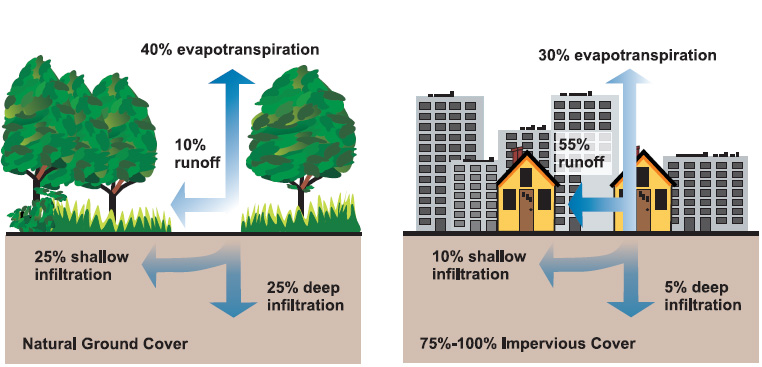
What a difference from our built environment where over half of the water that falls on site is wasted, taking soil and pollution along with it to clog waterways.  
Image courtesy of the EPA via Wikipedia, depicting two different types of built environment. In intact ecosystems, the amount of runoff is many times even less, although it varies by ecosystem type and local conditions. 
Fortunately, architects, planners, city officials, and politicians are realizing that in the process of developing our cities, we have destroyed native ecosystems and the services they provided. Through biomimicry and the "Genius of Place" process, we can begin to reverse this situation and the negative impacts we have created for ourselves. 

It's time to rethink the paradigm of stormwater as a waste product and look to nature for inspiration to make our buildings like trees, our cities like forests.

Discover innovative solutions to this and other challenges at the Chicago Biomimicry Immersion, starting April 25th at The Morton Arboretum! Be sure to enter the promo code "BIOCHI10" for 10% off the cost of registration!

Links for further reading:

Wednesday, March 4, 2015

Chicago Biomimicry Immersion - 2015!

In addition to running the B-Collaborative, Amy is a Partner and adult educator at Prairie Lab, LLC, and they are running a Biomimicry Immersion: Chicago-Style starting this April. Check out the webpage - with Amy's new video - to learn more! prairielab.com/immersion


Wednesday, September 24, 2014

Stories from the Prairie: Applying the “Genius of our Place” to Unlock Nature’s Strategies for Resilient, Restorative Design

Nature is inherently resilient and restorative while our human systems are...not. But what could we learn about the nature of design by studying the science of nature? By exploring our native organisms and ecosystems with a biomimicry lens, we can unlock nature’s locally-attuned design strategies and begin to apply them to our context: creating buildings, businesses and communities that are inherently sustainable, naturally.

Lurie Gardens. Photo by @amycoffman
In the other articles in this series, I wrote about the importance of connecting with nature and ways to do so. In this last (for a time, at least) article in this series, I share some stories of what I've learned in my exploration of the tallgrass prairie as well as a vision for a more sustainable and resilient world: one where our choices are based on working with and leveraging local context and energy flows rather than fighting against them.

It’s time to start thinking differently.


Like Wes Jackson who was inspired by the prairie to rethink industrial agriculture to Allan Savory who emulates grazing for holistic land management and Gerould Wilhelm who emulates the prairie in landscape design, each of these innovators look to the prairie ecosystem as inspiration for alternatives to standard practice. Doing so, they were able to (re)think standard practices, creating more low-maintenance, cost-effective, and biodiverse alternatives. And you can do this too.

Tuesday, August 5, 2014

Learn from Nature: Activities for Exploring Nature's Genius

After reading last week's entry, you may be thinking - I've found time to get outside, but what do I do now? Last week, we focused on the importance of getting outside and exploring nature as a part if your regular routine. This week, we will focus on what to do when you get there.

Photo by www.jennifermariephotography.net for @amycoffman
One of my favorite memories of the Biomimicry Professional program was that time spent in nature was built into course requirements. We called them "iSites" and every term I had a dozen or so structured exercises to complete. Some are simple observational exercises while others are more specific studies of particular components of an ecosystem. I have documented my contributions on this blog, so please browse the archives for 2011 and 2012 to see for yourself!

When I first started this practice, I had no idea what I was doing. As an architect with little training in the sciences after graduating from high school, it was a daunting task to go out and observe something I felt I knew little about. That's why these exercises are so powerful - they give us a chance to quiet our minds and focus on one aspect of what we observe. With this focus, we are able to see things from a fresh pair of eyes and start to ask questions. And this is the practice of biomimicry - observing nature with an eye for how things work so that those lessons may be applied to our challenges.

Tuesday, July 29, 2014

(Re)Connecting with Nature: Exploring Biomimicry in Our Local Ecosystems

Whenever I talk about biomimicry, I am usually asked a question along the lines of “how do I get started?” And the answer is remarkably simple - you start by going outside. Going for a walk through your local ecosystem, setting aside all that you need to do, reawakening your natural curiosity, and experiencing nature’s genius is a powerful act that will change your perspective on nature, your place in it, and forever alter the path of your career and life.


I recently had the opportunity to lead a biomimicry walk through the tallgrass prairie reconstruction at the Chicago Center for Green Technology, and I want to share some of the stories I tell when walking through the local ecosystems with a biomimicry lens. This article is the first in a series that explores the importance of reconnecting with nature, and how that simple act can have multiple benefits for the humans species to lead more sustainable, resilient, and connected lives.

Wednesday, May 7, 2014

Dormancy as an Energy Strategy: Learning from our Native Prairie

It’s been a long winter! Can you remember last summer’s lush green prairies when looking at them today, just emerging from their brown and dormant stage? As we drag ourselves out of our own winter dormancy and into the full light of spring, let’s take a moment to consider how our buildings and businesses can begin to emulate the biomimicry Life’s Principle to “Leverage Cyclic Processes” by embedding the ability to automatically respond to local conditions.
By understanding how ecosystems, like our native tallgrass prairie, are attuned to local conditions, we can begin to design buildings that optimize resource allocation while being more responsive to user needs. 

Sunday, April 27, 2014

Top 10 things kids can do to connect with nature!

  1. Get outside and explore. Enjoy the outdoors by going for walks, meeting animals at the zoo, and taking hikes through the woods.
  2. Ask lots of questions. Be curious about the world around you – ask and answer lots of questions.
  3. Show and tell. Pick up objects in nature – leaves, pine cones, feathers – and ask what they are and what they do.
  4. Take only what you need. Buy less stuff, reuse what you can, and recycle when you are done with it.
  5. Celebrate the seasons. Celebrate the change of the seasons by picking seasonal flowers for your parents.
  6. Limit screen time. Connect with friends and family by going for walks, playing games, and playing outside –away from a screen.
  7. Grow your favorite foods. Start a garden that grows some of your favorite foods and share them with your family.
  8. Let bugs be. Bugs are our friends, so be careful with them when playing outside and catch and release them from your home.
  9. Turn waste into food. Collect kitchen scraps and compost them outside – they make great food for your garden.
  10. Make an animal friend. Find an animal to be friends with and share your experiences with them – we are all a part of nature!
Content developed by The B-Collaborative for Nature’s Next: Raising Kids Connected with Nature. All rights reserved. Contact biomimicry@b-collaborative.com or visit www.b-collaborative.com/education.html for more information. 

Thursday, January 2, 2014

Waste is Normal?? Lessons from a Bird Feeder


My husband has become a birder. He hung up a bird feeder on our back porch and every few minutes or so I catch him looking outside to see who is munching away on his treats. He checked out a bird field guide from the library and keeps telling me the names of the various finches, sparrows, and our beloved cardinals that pay us a visit. His love for the birds is a treat for me to see because as a lifelong asthmatic with allergies to "everything alive", he doesn't get many opportunities to interact closely with nature. But his bird friends are perfect - he can enjoy them, learn about them, and they don't stay in his house and make him sneeze!

I can't remember the names of the bird species that pay us a visit (my memory is notoriously terrible), but remembering the names of the species isn't as appealing to me as trying to figure out how they work and what lessons we can learn from them. So what is my main takeaway from observing our bird friends so far? 

Waste is normal. 

This observation is a bit shocking to me. It flies in the face of all sustainability theory I've read and practiced for the last fifteen years, so so how can I observe that waste is normal? Because it is, when you look at component parts in isolation without seeing the larger system. Not every species can consume the entirety of the resources that are offered. Sometimes, there is waste, but this waste is readily taken up by another component, resulting in a zero-waste system.