Tuesday, May 26, 2015

Collective Resilience


Mention the term "swarm theory" and people typically think of robots that work together or accident-avoiding cars, but conversations I've been having recently are all about bringing swarm theory to work for human behavior. In a nutshell: how can we set up structures within our businesses, organizations, and communities that incentivize individuals to work together toward a common goal? 

I've written about swarm theory in relation to communication issues in a previous entry, and building on that, how can we leverage the mechanisms behind this innate behavior to create strategic alignment for our businesses and communities? The mechanisms in swarm theory are simple: individual organisms working together to create a whole that is greater than the sum of their parts. Through information transparency, multiple sensors, and simple rules, flocks and swarms are able to leverage the self-interest of the individual to work together and mitigate disturbances, such as predation. The biological mechanisms are simple, but translating them to a human context is anything but elementary.

Perhaps you are asking yourself:
How can I grow my business while keeping my culture intact? How can my organization cut through the noise to spread the word on an important initiative? How can I organize my community to collectively tackle initiatives that mitigate the effects of urban flooding, crime, and climate change? 
Let's start learning from billions of years of nature's R&D and work together to bring natural solutions to work for our businesses, organizations, and communities. Contact us to learn more!

Resources to learn more!

Wednesday, April 15, 2015

Exploring Synergies: Biomimicry's Genius of Place and the Living Building Challenge

I recently started a conversation with biomimicry friends and colleagues about the synergies between The Global Biomimicry Network's Genius of Place initiatives (affectionately referred to as "GoP") and the Living Building Challenge ("LBC"), specifically Imperative #9: Biophilic Environment. For those of us interested in emulating nature's forms, processes, and systems in the built environment, it is an interesting area to explore! I've synthesized initial our thoughts in this blog entry, but we need to continually adapt and grow our thinking on this subject. We would love to hear your thoughts as well - please join the conversation and let us know what you think!

Here is how the LBC 3.0 Imperative #9 is written:
Living Building Challenge 3.0: Imperative #9 Biophilic Environment
Of the imperative's above, I would like to particularly highlight the following:
"(Show) how the project will be uniquely connected to the place, climate and culture through Place-based Relationships."
and
"The plan should include historical, cultural, ecological, and climatic studies that thoroughly examine the site and context for the project."
So what does this mean for practitioners who are interested in meeting Living Building Challenge standards while fostering an intrinsic connection to place through biomimicry? And how do we communicate the value of a regional and site-specific Genius of Place initiative without confusing people with all the "Bio" terms? (See Terrapin Bright Green's amazing post on this subject to learn more about the distinction.)

Thursday, April 9, 2015

How does nature manage stormwater?

Image and article by Amy Coffman Phillips (cross posted with Biomimicry Chicago)
On a stormy day like today, we remember that water - life giving resource that it is - can cause big problems for the built environment! Maybe you are worried about your basement flooding. Or that your car will get stuck as flash floods cover roadways. Maybe you worry about water infiltrating your building, damaging finishes and inviting mold. The question we must ask is: are these problems inherent in the process of development or are they signs that we are managing stormwater incorrectly? 

Through biomimicry, we can find innovative solutions to this challenge by asking the question: "how does nature manage stormwater?"

As an architect, one of my primary responsibilities is to "keep water out" of buildings. Often, that means finding ways to accelerate the flow of water off the roof and away from the site. We do this with impermeable surfaces, downspouts, drainage channels, drain tile, and much more. The goal is to get water off and away as soon as possible, treating it as a waste product. But in nature, the strategy is the opposite of acceleration, but to slow the flow. Water is slowed in a many ways at a variety of scales. 

Let's think like a forest. 

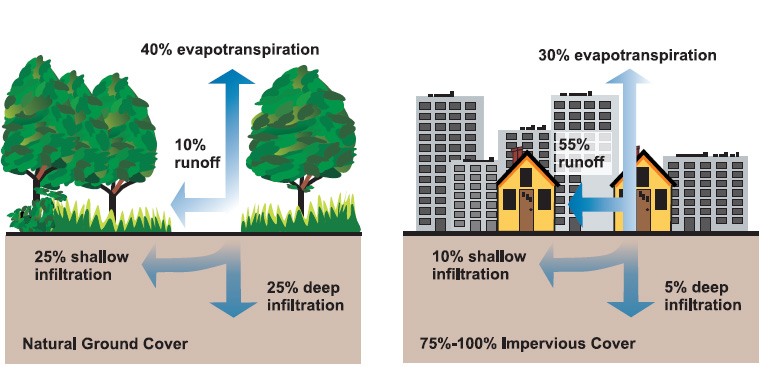
Canopy trees are the first defense: slowing the fast moving water that falls from the sky and breaking it up into smaller droplets. Then understory trees, shrubs, and ground cover further serve to break apart water drops and slow the flow until they fall to the soil and are readily absorbed by spongy soil architecture. Excess water that is not readily absorbed runs off but is impacted by logs, twigs, rocks, and other obstructions that serve to further slow this acceleration. The result is that only a very small percentage of the water that falls from the sky actually runs off to streams and rivers in intact ecosystems. 

What a difference from our built environment where over half of the water that falls on site is wasted, taking soil and pollution along with it to clog waterways.  
Image courtesy of the EPA via Wikipedia, depicting two different types of built environment. In intact ecosystems, the amount of runoff is many times even less, although it varies by ecosystem type and local conditions. 
Fortunately, architects, planners, city officials, and politicians are realizing that in the process of developing our cities, we have destroyed native ecosystems and the services they provided. Through biomimicry and the "Genius of Place" process, we can begin to reverse this situation and the negative impacts we have created for ourselves. 

It's time to rethink the paradigm of stormwater as a waste product and look to nature for inspiration to make our buildings like trees, our cities like forests.

Discover innovative solutions to this and other challenges at the Chicago Biomimicry Immersion, starting April 25th at The Morton Arboretum! Be sure to enter the promo code "BIOCHI10" for 10% off the cost of registration!

Links for further reading:

Wednesday, March 4, 2015

Chicago Biomimicry Immersion - 2015!

In addition to running the B-Collaborative, Amy is a Partner and adult educator at Prairie Lab, LLC, and they are running a Biomimicry Immersion: Chicago-Style starting this April. Check out the webpage - with Amy's new video - to learn more! prairielab.com/immersion


Wednesday, September 24, 2014

Stories from the Prairie: Applying the “Genius of our Place” to Unlock Nature’s Strategies for Resilient, Restorative Design

Nature is inherently resilient and restorative while our human systems are...not. But what could we learn about the nature of design by studying the science of nature? By exploring our native organisms and ecosystems with a biomimicry lens, we can unlock nature’s locally-attuned design strategies and begin to apply them to our context: creating buildings, businesses and communities that are inherently sustainable, naturally.

Lurie Gardens. Photo by @amycoffman
In the other articles in this series, I wrote about the importance of connecting with nature and ways to do so. In this last (for a time, at least) article in this series, I share some stories of what I've learned in my exploration of the tallgrass prairie as well as a vision for a more sustainable and resilient world: one where our choices are based on working with and leveraging local context and energy flows rather than fighting against them.

It’s time to start thinking differently.


Like Wes Jackson who was inspired by the prairie to rethink industrial agriculture to Allan Savory who emulates grazing for holistic land management and Gerould Wilhelm who emulates the prairie in landscape design, each of these innovators look to the prairie ecosystem as inspiration for alternatives to standard practice. Doing so, they were able to (re)think standard practices, creating more low-maintenance, cost-effective, and biodiverse alternatives. And you can do this too.